
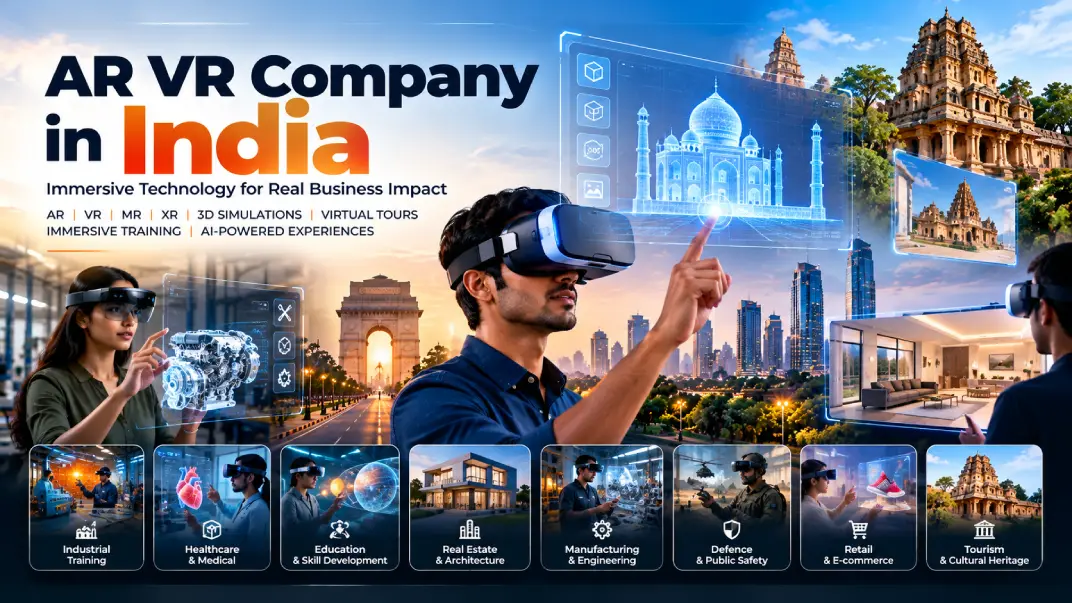
Looking for an AR VR company in India to build immersive experiences, training simulations, 3D applications or enterprise solutions? This guide explains what AR and VR development companies offer, where immersive technology is being used, what it costs, and how to choose the right technology partner for your project.
India has developed a strong ecosystem of software engineers, 3D artists, game developers, AI specialists and immersive technology professionals. As businesses look beyond conventional websites and applications, Augmented Reality (AR), Virtual Reality (VR), Mixed Reality (MR) and 3D simulations are becoming practical tools for training, product visualization, education, healthcare, manufacturing, defence, real estate, retail and customer engagement.
For businesses evaluating an AR VR company in India, the important question is not simply whether a company can create a virtual environment. The real question is whether it can connect immersive technology to a measurable business objective.
What Is an AR VR Company?
An AR VR company develops software, applications and immersive experiences using technologies such as:
- Augmented Reality
- Virtual Reality
- Mixed Reality
- Extended Reality (XR)
- 3D modelling
- 3D visualization
- Virtual simulations
- Interactive environments
- Digital twins
- Computer vision
- Spatial computing
- AI-powered immersive applications
- Gamification
An AR/VR development company may work on anything from a smartphone-based AR application to a fully immersive VR training simulator involving 3D environments, interactive objects, controllers, spatial audio and performance analytics.
The right technology depends on the problem being solved.
AR vs VR vs MR: What Is the Difference?
Understanding the difference between these technologies is important before selecting an AR VR development company in India.
Augmented Reality — AR
AR adds digital information or 3D objects to the real-world environment.
Examples include:
- AR product visualization
- Interactive product catalogues
- AR education applications
- Maintenance assistance
- Navigation
- Marketing campaigns
- Try-before-you-buy experiences
- Museum and tourism experiences
AR can often be accessed through smartphones, tablets, smart glasses or dedicated AR devices.
Virtual Reality — VR
VR places the user inside a computer-generated environment.
Common applications include:
- Industrial training
- Safety training
- Emergency response simulations
- Defence training
- Healthcare simulations
- Aviation training
- Fire safety simulations
- Equipment operation
- Virtual tours
- VR gaming
- Skill development
VR is particularly useful when an organisation needs to reproduce an environment that may be expensive, dangerous or impractical to access physically.
Mixed Reality — MR
MR combines physical and digital environments so that virtual objects can interact with the real environment.
MR can be useful for:
- Product design
- Engineering
- Remote assistance
- Collaborative work
- Medical applications
- Industrial visualization
- Training
- Digital twins
Together, AR, VR and MR are often grouped under the broader term XR — Extended Reality.
What Services Does an AR VR Company in India Provide?
A professional AR/VR development company can provide much more than headset-based experiences.
1. AR Application Development
AR applications can transform smartphones, tablets and wearable devices into interactive digital interfaces.
Solutions may include:
- Marker-based AR
- Markerless AR
- Location-based AR
- Object recognition
- Face tracking
- 3D product visualization
- Interactive AR experiences
- AR navigation
- AR marketing applications
- AR maintenance assistance
2. VR Application Development
VR development creates immersive environments where users can interact with virtual objects and scenarios.
Applications include:
- VR training
- Safety simulations
- Industrial simulations
- Healthcare simulations
- Defence training
- Virtual classrooms
- VR tourism
- Virtual events
- Virtual showrooms
- Gaming
- Employee onboarding
3. 3D Modelling and Visualization
High-quality 3D assets are fundamental to many AR and VR projects.
A development company may create:
- Machinery models
- Buildings
- Factories
- Vehicles
- Medical models
- Industrial equipment
- Products
- Human anatomy models
- Training environments
- Architectural environments
These models can then be integrated into AR, VR, web, mobile or simulation applications.
4. VR Training Simulations
One of the strongest enterprise applications of VR is training.
Instead of placing employees directly into a dangerous or expensive environment, companies can create a simulated environment where employees can practice procedures safely.
Examples include:
- Fire safety
- Industrial safety
- Railway safety
- Equipment operation
- Emergency response
- Manufacturing processes
- Defence scenarios
- Aviation procedures
- Oil and gas operations
- Healthcare procedures
VR training can also incorporate scoring, assessments, decision-making and performance tracking.
5. AR Training Solutions
AR can bring digital instructions into the employee's physical environment.
For example, a technician could use an AR device to view:
- Equipment information
- Assembly instructions
- Maintenance steps
- Warning indicators
- Interactive diagrams
- Repair instructions
- Safety procedures
This can reduce dependence on printed manuals and make complex procedures easier to understand.
6. Mixed Reality Development
MR applications can combine physical equipment with digital information.
Potential applications include:
- Engineering
- Manufacturing
- Healthcare
- Product design
- Education
- Collaboration
- Industrial training
- Digital twins
7. Interactive 3D Experiences
Not every immersive experience needs a VR headset.
Interactive 3D applications can be delivered through:
- Websites
- Desktop applications
- Mobile applications
- Touchscreen kiosks
- Large displays
- Interactive exhibitions
- Digital museums
- Experience centres
This makes immersive technology accessible to a much larger audience.
8. Digital Twin Solutions
Digital twins create digital representations of physical assets, products, machines, facilities or processes.
A digital twin can potentially combine:
3D + IoT + Data + AI + AR/VR
This allows organisations to visualize assets, monitor information and simulate scenarios digitally.
9. Virtual Tours and Virtual Showrooms
Businesses can create immersive experiences for customers without requiring physical visits.
Applications include:
- Real estate
- Hotels
- Tourism
- Education
- Automotive
- Manufacturing
- Retail
- Museums
- Corporate facilities
A virtual showroom can allow customers to explore products and environments interactively.
Industries Using AR and VR in India
AR and VR are no longer limited to gaming and entertainment.
Manufacturing
Manufacturers can use immersive technology for:
- Employee training
- Equipment simulations
- Assembly training
- Maintenance
- Product design
- Safety training
- Factory visualization
- Digital twins
Healthcare
Potential applications include:
- Medical education
- Surgical simulations
- Anatomy visualization
- Patient education
- Rehabilitation
- Healthcare training
Defence and Public Safety
Immersive simulations can provide controlled environments for:
- Emergency response
- Tactical training
- Fire safety
- Disaster management
- Equipment training
- Scenario-based learning
Education
Educational institutions can use AR/VR for:
- Virtual laboratories
- Historical experiences
- Science visualization
- Engineering training
- Medical education
- Skill development
- Experiential learning
Real Estate
AR and VR can help buyers experience properties before construction or without visiting the site.
Applications include:
- Virtual property tours
- 3D walkthroughs
- Interior visualization
- Architectural visualization
- Property configurators
Automotive
Applications include:
- Vehicle visualization
- Virtual showrooms
- Design review
- Training
- Maintenance assistance
- Marketing experiences
Retail and E-commerce
AR can allow customers to visualize products before purchasing them.
Examples include:
- Furniture placement
- Jewellery visualization
- Fashion experiences
- Product visualization
- Interactive catalogues
Tourism and Cultural Heritage
Museums, heritage organisations and tourism businesses can use AR/VR to create:
- Virtual tours
- Historical reconstructions
- Interactive exhibitions
- Immersive storytelling
- Digital museums
- Cultural experiences
AR VR Development Company in India: What Technologies Are Used?
An experienced AR/VR development team may work with a combination of technologies rather than one single platform.
Depending on the project, the technology stack may include:
Game Engines
- Unity
- Unreal Engine
Programming
- C#
- C++
- Python
- JavaScript
- TypeScript
3D Development
- Blender
- 3ds Max
- Maya
- Substance tools
- CAD integrations
Computer Vision
- Object detection
- Image recognition
- Spatial mapping
- Motion tracking
- Hand tracking
AI
AI can be integrated into immersive experiences for:
- Intelligent virtual assistants
- Conversational avatars
- Personalised training
- Behaviour analysis
- Object recognition
- Automated assessment
- Predictive analytics
Hardware
Depending on the application, solutions may support:
- VR headsets
- AR glasses
- MR headsets
- Smartphones
- Tablets
- Motion controllers
- Tracking systems
- Interactive displays
How Much Does AR VR Development Cost in India?
The cost of an AR/VR project depends heavily on its complexity.
A simple AR application and a high-fidelity industrial VR simulator are completely different projects.
The main cost factors include:
1. Project Complexity
A basic AR experience will generally require fewer development resources than a large multi-user VR simulation.
2. 3D Asset Requirements
Existing 3D models can reduce development time.
Creating detailed models from scratch increases the project scope.
3. Interactivity
Simple visualization is different from a simulation where users can:
- Pick up objects
- Operate machines
- Make decisions
- Trigger events
- Complete tasks
- Receive feedback
4. Hardware
Headsets, controllers, sensors, tracking systems and specialised hardware can affect the overall budget.
5. Backend and Analytics
Enterprise applications may require:
- User management
- Authentication
- Cloud infrastructure
- Dashboards
- Performance analytics
- Reporting
- Integration with existing systems
6. AI Integration
AI-powered features can increase development complexity but can also make the application considerably more useful.
Indicative Project Categories
Instead of using one fixed price for every AR/VR project, businesses should request a project-specific estimate based on:
Concept → 3D assets → interaction → platform → hardware → backend → analytics → deployment → support
A professional AR VR company should ideally provide a scope-based proposal rather than an arbitrary single price.
How to Choose the Best AR VR Company in India?
Choosing the right company is more important than simply choosing the company with the most impressive demo.
Consider these factors.
1. Portfolio
Ask to see projects similar to yours.
A gaming-focused studio may not necessarily be the right choice for an industrial training simulator.
2. Industry Experience
Look for experience in your industry.
For example:
- Manufacturing
- Healthcare
- Education
- Defence
- Real estate
- Retail
- Automotive
3. Technology Expertise
Check whether the company has expertise in:
- AR
- VR
- MR
- 3D
- Unity
- Unreal Engine
- AI
- Computer vision
- Cloud
- Mobile development
4. Hardware Compatibility
Ask which devices the application will support.
5. Scalability
An enterprise solution should be designed for future expansion.
6. Analytics
For training applications, analytics can be particularly important.
You may want to measure:
- Completion rate
- Score
- Errors
- Time taken
- Attempts
- User performance
- Training progress
7. Support and Maintenance
AR/VR projects often require updates after deployment.
Make sure the development partner provides a clear support model.
Why Choose an Indian AR VR Development Company?
India offers a large technology talent ecosystem spanning software engineering, 3D development, AI, mobile applications and digital product development.
For international organisations, working with an Indian AR/VR development company can provide access to multidisciplinary development teams.
Potential advantages include:
- Software engineering expertise
- 3D development capabilities
- AI expertise
- Flexible development models
- Product development experience
- Cost-effective engineering
- Remote collaboration
- Long-term technical support
However, price should not be the only reason to choose an Indian technology partner.
The more important factors are technical capability, domain understanding, project management, quality and long-term support.
TechQRT — AR VR Company in India
TechQRT is an India-based technology company working across software development, AI, 3D and immersive technology.
The company's immersive technology capabilities include:
- Augmented Reality
- Virtual Reality
- Mixed Reality
- 3D modelling
- 3D simulations
- Interactive experiences
- VR training
- Digital experiences
- AI-powered applications
What makes an AR/VR project more valuable is its connection with the rest of the technology ecosystem.
For example, a VR training application may need:
3D Environment + VR Interaction + AI + Backend + User Management + Analytics + Dashboard
Instead of treating immersive technology as an isolated experience, TechQRT can combine it with software engineering, AI, applications and data systems.
This approach can be useful for organisations looking to build enterprise-grade immersive solutions rather than standalone demonstrations.
AR VR Solutions for Training and Simulation
Training is one of the most practical applications of immersive technology.
Imagine an employee learning how to respond to a fire emergency.
Instead of simply watching a video, the trainee can enter a virtual environment where they have to:
- Identify the emergency.
- Assess the situation.
- Locate safety equipment.
- Select the appropriate response.
- Perform the required actions.
- Make decisions under pressure.
- Complete the scenario.
- Receive a performance assessment.
The same concept can be adapted for different industries and scenarios.
This is where VR simulation development can move beyond entertainment and become a serious enterprise training technology.
AR VR + AI: The Next Generation of Immersive Applications
The combination of AI and immersive technology is opening new possibilities.
An AR/VR application can incorporate AI for:
Intelligent Virtual Characters
AI-powered characters can interact with users and respond to their actions.
Personalised Training
The system can adjust scenarios according to the user's performance.
Automated Assessment
AI can analyse user behaviour and identify mistakes.
Computer Vision
Computer vision can help applications understand objects, environments and user actions.
Conversational Interfaces
Users can interact with virtual assistants using natural language.
Predictive Analytics
Training and operational data can be analysed to identify patterns and improvement opportunities.
The combination of AI + 3D + AR/VR can therefore create much more intelligent immersive experiences.
AR VR Company in India vs Traditional Software Company
Not every software development company is an AR/VR company.
AR/VR development requires additional expertise in areas such as:
- 3D mathematics
- Real-time rendering
- Spatial interaction
- Game engines
- 3D asset creation
- Motion tracking
- Hardware integration
- Immersive UX
- Performance optimisation
When selecting a technology partner, check whether the company has actual immersive development capabilities rather than simply listing AR/VR among its services.
AR VR Development Process
A typical AR/VR project can follow these stages:
Step 1: Discovery
Understand the business problem, users and desired outcome.
Step 2: Concept
Define the immersive experience and user journey.
Step 3: Prototype
Build an initial proof of concept.
Step 4: 3D Development
Create or optimise the required environments and assets.
Step 5: Application Development
Develop the AR, VR or MR application.
Step 6: Integration
Connect APIs, databases, AI, analytics and enterprise systems where required.
Step 7: Testing
Test performance, usability, hardware compatibility and interaction.
Step 8: Deployment
Deploy the application to the selected devices or platforms.
Step 9: Training and Support
Provide user training, documentation, maintenance and future upgrades.
What Should You Ask an AR VR Company Before Starting?
Before signing a development contract, ask:
- Have you developed a project similar to ours?
- Which AR/VR devices will be supported?
- Which game engine will you use?
- Who will create the 3D assets?
- Can the application work offline?
- Will we receive the source code?
- How will user data be stored?
- Can the application integrate with our existing software?
- Will analytics be included?
- What happens after deployment?
- What is included in the maintenance agreement?
- How will future hardware be supported?
These questions can prevent major problems later.
Frequently Asked Questions
Which is the best AR VR company in India?
There is no single AR/VR company that is best for every project. The right partner depends on the project's industry, technology, hardware, complexity, budget and required outcome.
How much does AR/VR development cost in India?
AR/VR development costs vary significantly depending on 3D complexity, interactivity, hardware, AI, backend systems, analytics and deployment requirements. A project-specific proposal is more useful than a generic price.
What is the difference between AR and VR?
AR adds digital information to the real world, while VR places users inside a completely simulated environment.
Which industries use VR?
VR is used in industries including manufacturing, healthcare, education, defence, public safety, aviation, automotive, real estate, tourism and entertainment.
Can AR/VR be used for employee training?
Yes. VR can simulate complex or dangerous environments, while AR can provide contextual information and instructions within real-world environments.
Can AI be integrated with AR and VR?
Yes. AI can support virtual assistants, intelligent characters, computer vision, personalised training, automated assessment, analytics and adaptive simulations.
Can an AR/VR application connect to existing business software?
Yes. Enterprise AR/VR applications can be integrated with APIs, databases, ERP systems, CRM platforms, learning management systems and other enterprise applications.
Does TechQRT develop AR and VR applications?
Yes. TechQRT provides AR, VR, MR, 3D modelling and immersive technology solutions as part of its technology and digital development capabilities.
Can TechQRT build VR training simulations?
Yes. VR simulations can be developed for training, safety, emergency response, industrial processes, education and other scenario-based applications.
Final Thoughts
AR and VR are moving beyond gaming into practical applications across training, manufacturing, healthcare, education, defence, real estate, retail, tourism and enterprise operations.
The best AR VR projects are not built simply to demonstrate impressive graphics. They are designed around a specific business problem.
Whether you need an AR application, VR training simulator, 3D experience, mixed reality solution, digital twin or AI-powered immersive platform, choosing a development partner with the right combination of engineering, 3D, AI and domain expertise can make a significant difference.
If you are looking for an AR VR company in India, TechQRT can help transform your concept into a practical immersive technology solution — from concept and 3D development to application engineering, AI integration, deployment and support.
Have an AR/VR project in mind? Talk to TechQRT about your requirements and explore the right technology approach for your organisation.