
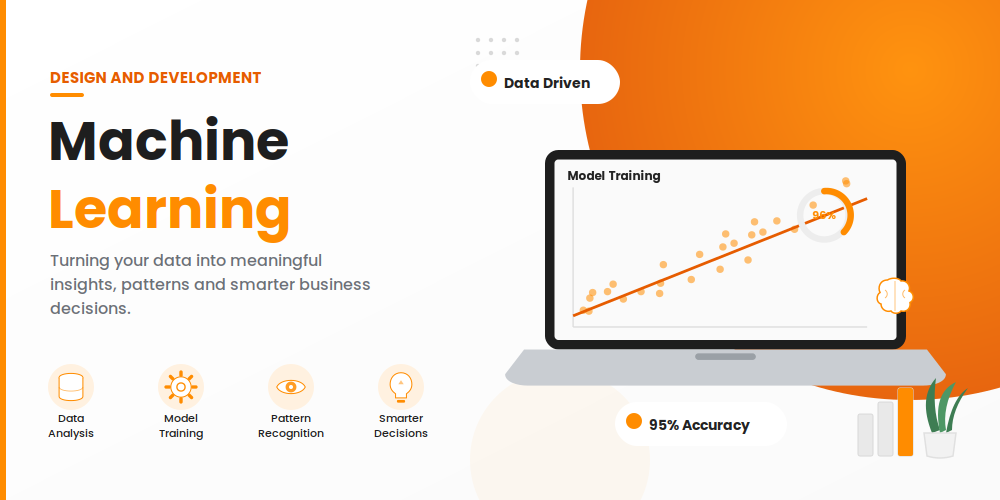
In the evolving landscape of technology, Machine Learning (ML) has emerged as a powerful catalyst for innovation, driving smarter decisions and automating complex processes. Machine Learning application development represents a transformative phase in how businesses harness data — enabling systems to learn, adapt, and improve without explicit programming. This article explores the core concepts, challenges, and real-world applications of Machine Learning, showcasing its immense potential to reshape industries across the globe.
1. Introduction to Machine Learning
Machine Learning is a branch of Artificial Intelligence (AI) that empowers computer systems to learn from data and improve their performance over time. Instead of relying solely on pre-defined instructions, ML models identify patterns, make predictions, and optimize results based on experience. From personalized recommendations to autonomous vehicles, ML is the backbone of modern intelligent applications.
2. Core Concepts of Machine Learning
At its foundation, Machine Learning operates through algorithms designed to extract insights from massive datasets. The primary learning approaches include:
Supervised Learning – Models learn from labeled datasets to make accurate predictions. (e.g., spam email detection, price forecasting)
Unsupervised Learning – The system uncovers hidden patterns in unlabeled data. (e.g., customer segmentation)
Reinforcement Learning – Algorithms learn through trial and error, receiving rewards or penalties for specific actions. (e.g., robotics, gaming)
These techniques together form the basis for most ML-powered applications today.
3. Deep Learning and Neural Networks
Deep Learning, a specialized subset of Machine Learning, utilizes artificial neural networks inspired by the human brain. These multi-layered networks enable systems to analyze complex data like images, audio, and natural language. Deep Learning powers applications such as facial recognition, voice assistants, and self-driving cars, pushing the boundaries of what machines can perceive and understand.
4. Natural Language Processing (NLP) with ML
Natural Language Processing (NLP) enables machines to understand, interpret, and generate human language. Through ML-powered NLP, applications like chatbots, virtual assistants, and language translators are able to process vast amounts of text data with contextual understanding. Modern NLP models such as BERT and GPT have revolutionized conversational AI and sentiment analysis.
5. Computer Vision
Computer Vision combines ML and Deep Learning to interpret visual data. From detecting objects in photos to enabling autonomous navigation, ML models trained on image datasets help machines “see” and respond intelligently. Popular frameworks like OpenCV and TensorFlow play a major role in developing vision-based applications used in healthcare, retail, and security.
6. Reinforcement Learning
Reinforcement Learning (RL) teaches systems to make goal-oriented decisions through feedback loops. Using a reward-based approach, RL helps machines learn optimal strategies over time. It’s widely used in robotics, recommendation engines, and real-time bidding systems, where dynamic decision-making is critical.
7. Machine Learning in Healthcare
ML is transforming the healthcare industry by enabling faster, more accurate diagnoses and predictive analytics. Applications include:
Disease detection using medical imaging
Predictive modeling for patient outcomes
Personalized treatment recommendations
Machine Learning also assists in drug discovery, accelerating the process of finding effective compounds and treatments.
8. Machine Learning in Finance
The financial industry leverages ML for fraud detection, credit scoring, and algorithmic trading. By analyzing transaction patterns, ML models identify suspicious behavior in real time. Financial institutions also use predictive analytics to forecast market trends and enhance customer experiences through personalized product recommendations.
9. Machine Learning in Marketing
Machine Learning helps marketers understand customer behavior, optimize campaigns, and deliver hyper-personalized content. By analyzing vast datasets from social media and web activity, ML models power:
Predictive lead scoring
Customer segmentation
Sentiment analysis
Dynamic ad targeting
These insights enable smarter marketing strategies and higher conversion rates.
10. Machine Learning in Education
In education, ML applications promote personalized learning paths by adapting course content based on each student’s pace and understanding. Intelligent tutoring systems and learning analytics help educators identify struggling students early. ML-driven chatbots and virtual assistants simplify administrative processes and student support.
11. Machine Learning in Autonomous Systems
Self-driving cars, drones, and robotic systems rely heavily on ML to make split-second decisions. By processing sensory data in real-time, ML algorithms allow these systems to detect obstacles, predict movement patterns, and navigate safely. The integration of ML with IoT devices further enhances automation and efficiency across industries.
12. Challenges in Machine Learning Application Development
While Machine Learning offers vast potential, its development comes with key challenges:
Data Quality & Bias: Models are only as good as the data they are trained on. Poor or biased data can produce misleading results.
Model Interpretability: Complex ML models can act as “black boxes,” making it difficult to explain how decisions are made.
Ethical & Privacy Concerns: Data security, algorithmic fairness, and responsible AI practices are vital.
Scalability & Infrastructure: Large-scale ML applications demand high computational power and optimized infrastructure.
Regulatory Compliance: Adhering to global data protection laws (like GDPR) is essential in ML-based solutions.
13. Popular Machine Learning Frameworks and Tools
Developers rely on robust frameworks to streamline ML development:
TensorFlow – Google’s open-source ML framework for building and deploying large-scale models.
PyTorch – Favored for research and rapid prototyping with its dynamic computation graph.
Scikit-learn – Ideal for beginners, offering efficient tools for data preprocessing and model evaluation.
Keras – Simplifies deep learning development with an intuitive, high-level API.
OpenCV – Essential for computer vision applications and image processing.
14. The Future of Machine Learning
The future of Machine Learning is full of promise, driven by continuous innovation:
Explainable ML: Enhancing transparency and trust through interpretable models.
Edge ML: Deploying ML on edge devices for faster, low-latency decision-making.
Generative ML: Models like GANs and diffusion models are enabling creative applications in art, music, and content generation.
AutoML: Automating the process of building and tuning ML models, making ML accessible to non-experts.
ML for Sustainability: Optimizing energy usage, waste management, and resource allocation through intelligent predictions.
Machine Learning is not just a technological trend — it’s the driving force behind the next wave of digital transformation. By enabling data-driven decisions, automating tasks, and uncovering hidden insights, ML continues to redefine how we work, live, and innovate. As frameworks evolve and ethical practices mature, the future of Machine Learning promises smarter, fairer, and more impactful applications across every industry.
For any requirement for application development and to train it, feel free to contact TechQRT.