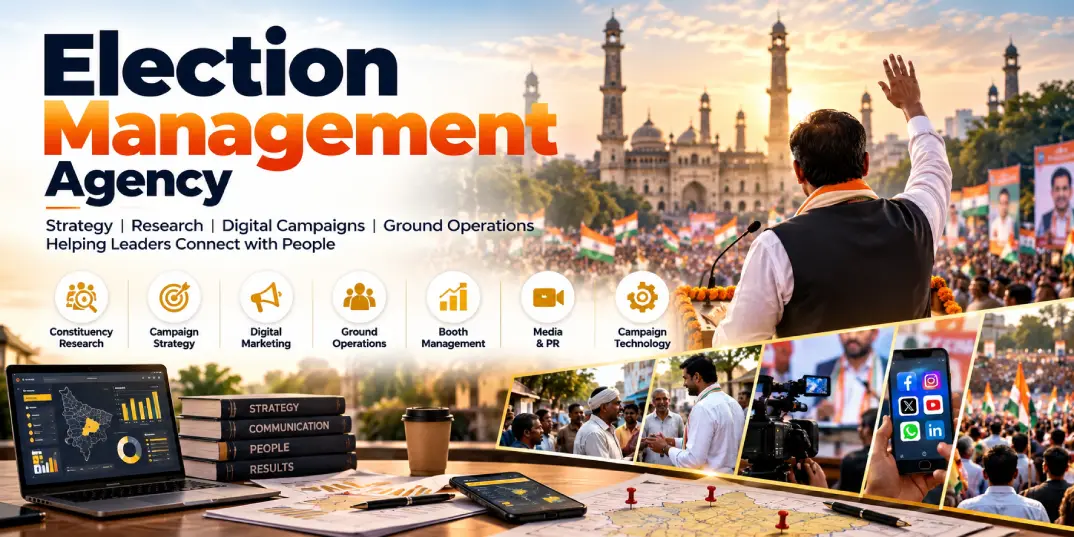
Elections require much more than rallies, posters and social media posts. A well-organised election campaign depends on clear planning, an understanding of local issues, effective communication, coordinated field operations and timely execution. This is where an election management agency can help candidates, political parties and campaign teams bring their activities together under a structured strategy.
From constituency research and campaign planning to political PR, digital communication, volunteer coordination and election-day operations, professional campaign management can help teams use their time and resources more efficiently.
For candidates looking for an election management agency in India, understanding the services available and knowing how to evaluate an agency are important first steps.
What Is an Election Management Agency?
An election management agency is a professional service provider that helps candidates, political parties and election teams plan, coordinate and execute campaign activities.
Depending on the scope of engagement, its responsibilities may include campaign research, communication planning, public outreach, digital media, creative production, field coordination, event management and campaign reporting.
A capable agency works alongside the candidate and their authorised team to turn campaign objectives into a practical execution plan. It can coordinate different workstreams, establish reporting processes and help identify operational gaps before they become larger problems.
Election management does not guarantee an electoral victory. Its purpose is to support better organisation, clearer communication, responsible outreach and more disciplined campaign execution.
Why Do Candidates Need Professional Election Campaign Management?
An election campaign involves many activities happening at the same time. Without defined responsibilities and a common plan, teams may face inconsistent messaging, duplicated work, delayed communication and poor coordination between digital and ground-level activities.
Professional election campaign management can help address these challenges in several ways.
1. Structured Campaign Planning
A campaign plan establishes priorities, responsibilities, timelines, resource requirements and measurable milestones. It helps the team understand what needs to happen, when it should happen and who is responsible.
2. Better Understanding of Constituency Issues
Local research can help campaign teams understand public concerns, infrastructure gaps, service-delivery issues and the topics residents want representatives to address. This research should be conducted transparently and interpreted carefully rather than treating limited survey results as a complete picture of public opinion.
3. Consistent Political Communication
Campaign messages need to remain clear and consistent across speeches, press interactions, websites, social media, printed materials and public meetings. A central communication plan helps maintain accuracy and avoid contradictory statements.
4. Coordination Between Online and Offline Campaigns
Digital campaigns and field activities are more effective operationally when they support the same communication plan. For example, a public meeting can be promoted online, documented through approved photographs and videos, and followed by a factual summary of the issues discussed.
5. Improved Resource Management
Budgets, campaign materials, staffing, transport, event arrangements and creative production all require coordination. Defined workflows and regular reporting can make it easier to monitor spending and allocate resources responsibly.
Core Services Offered by an Election Management Agency
Election management agencies offer different combinations of services. Candidates should confirm the scope, deliverables and responsibilities before signing an agreement.
1. Election Strategy and Campaign Planning
Strategy and planning provide the foundation for campaign execution. Activities may include:
- Reviewing the constituency's political and public-service context.
- Identifying major local issues through legitimate research.
- Establishing campaign objectives and communication priorities.
- Preparing an activity calendar and implementation roadmap.
- Assigning responsibilities to campaign staff and authorised representatives.
- Developing contingency plans for operational challenges.
A practical election campaign strategy should be based on evidence, realistic resources and clearly defined objectives.
2. Constituency Research and Public Opinion Surveys
Research helps campaign teams understand local priorities and assess whether their communication is addressing relevant concerns.
Depending on the research design, services may include household surveys, structured interviews, public consultations, telephone surveys and analysis of publicly available information.
A professional research process should explain its methodology, sample limitations, consent practices and data-handling procedures. Findings should be reported honestly, including uncertainty and conflicting opinions. Surveys should not be presented as reliable predictions of election results unless the methodology supports that interpretation.
3. Booth-Level and Field Campaign Coordination
Field coordination involves organising authorised campaign activities across a constituency. Depending on the engagement, this may include:
- Preparing field activity schedules.
- Coordinating campaign offices and local teams.
- Assigning responsibilities to authorised workers.
- Managing the distribution of approved campaign materials.
- Recording completed activities and operational issues.
- Coordinating public meetings and permitted outreach activities.
Booth-level planning must follow applicable election rules. Agencies should not use unauthorised voter information, obstruct polling processes or engage in activities that compromise electoral integrity.
4. Door-to-Door Outreach and Public Engagement
Direct engagement gives candidates an opportunity to hear residents' concerns and explain their public positions.
Campaign teams may organise neighbourhood visits, public consultations, issue-based meetings and door-to-door outreach where permitted. They can also maintain structured records of the concerns raised, with appropriate consent and safeguards for personal information.
The objective should be meaningful communication, not pressure or misleading promises. Residents should be treated respectfully regardless of their political preferences.
5. Political Digital Marketing and Social Media
Online platforms have become an important part of public communication. An election management agency may help create a consistent digital presence through:
- Social media content calendars.
- Candidate profiles and official campaign websites.
- Graphic design, photography and video production.
- Public speeches, interviews and event highlights.
- Issue explainers and policy communication.
- Website analytics and campaign performance reports.
- Digital advertising planning and monitoring, where permitted.
Content should be accurate, clearly attributable where required and compliant with platform policies and election advertising rules. Campaign teams should avoid fabricated claims, manipulated media presented as genuine, impersonation and deceptive engagement practices.
6. Political PR and Media Management
Political public relations involves communicating a candidate's positions, activities and public commitments clearly to media organisations and the wider public.
Services can include press releases, media briefings, interview coordination, event announcements, spokesperson preparation and factual responses to public questions.
A professional political PR team should prioritise verifiable information and transparent communication. It should not manufacture news coverage, circulate false allegations or misrepresent paid publicity as independent reporting.
7. Campaign Branding and Creative Production
Campaign materials help communicate a candidate's identity, priorities and public message.
Creative services may include:
- Campaign identity and visual guidelines.
- Posters, banners, brochures and leaflets.
- Short videos and documentary-style profiles.
- Public meeting backdrops and event signage.
- Approved audio-visual content.
- Digital creatives and campaign presentations.
All campaign materials should comply with applicable requirements concerning authorisation, printing details, expenditure and advertising disclosures.
8. Election Events, Rallies and Public Meetings
Campaign events involve logistics, permissions, venue planning, staffing, schedules and communication.
An agency may coordinate event vendors, production teams, stage arrangements, approved publicity, transport logistics and post-event reporting. The campaign team must obtain required permissions and follow relevant rules concerning public gatherings, safety, sound levels and expenditure.
9. Campaign Technology and Reporting
Technology can help campaign teams coordinate work across multiple locations and departments. Depending on the solution, campaign tools may support:
- Task and volunteer management.
- Event calendars and attendance records.
- Campaign activity dashboards.
- Material inventory and distribution tracking.
- Survey data collection and analysis.
- Issue tracking and field reporting.
- Budget monitoring and performance summaries.
The right system depends on the campaign's size and needs. Access controls, data minimisation, secure storage and appropriate retention policies are essential when systems process personal or campaign-related information.
10. Polling-Day Operational Coordination
Polling day requires careful planning within the law. Depending on the permitted scope of work, an agency may assist with internal communication, staff coordination, authorised observer schedules, incident escalation procedures and the organisation of campaign resources.
All activities must respect voter secrecy, polling-station rules, restricted areas, silence periods and directions issued by election authorities. Voter assistance and information must be lawful and non-coercive. Election officials, rather than private agencies, are responsible for administering the election.
How to Choose the Right Election Management Agency in India
Not every agency offers the same services or level of operational support. Before making a decision, consider the following factors.
Relevant Experience and Capabilities
Ask about comparable projects, the types of services delivered and the actual responsibilities handled by the agency. Request verifiable references or case studies where disclosure is authorised.
Do not rely only on claims about the number of elections won. Election outcomes depend on many factors, and claims about success rates should be supported by transparent evidence.
A Clear Scope of Work
The proposal should explain exactly what is included. For example, strategy consulting may not include field staff, printing, video production, paid advertising or event logistics.
Ask for a written breakdown of deliverables, staffing, timelines, exclusions and additional costs.
Research and Reporting Quality
Check how the agency collects information, validates findings and reports progress. Reports should distinguish verified facts from assumptions and clearly disclose research limitations.
Digital and Technology Capabilities
If digital communication is part of the plan, evaluate the team's experience with websites, content production, analytics, digital advertising and campaign reporting. Confirm who owns the campaign accounts, data and creative assets.
Local Knowledge and Field Coordination
Local knowledge can help with logistics, languages, community engagement and an understanding of public issues. For a geographically large campaign, ask how the agency will manage communication and quality control across locations.
Compliance and Data Protection
Ask how the agency handles election permissions, advertising disclosures, campaign expenditure records, personal information and vendor management. Responsibilities should be documented rather than left to informal assurances.
Transparent Pricing
Request a detailed estimate covering professional fees, field operations, creative production, travel, printing, advertising and technology. Confirm whether taxes and third-party expenses are included.
A reliable proposal makes the cost structure understandable and avoids promising guaranteed results.
How Much Does Election Management Cost?
The cost of hiring an election management agency varies according to the campaign's scale and complexity. There is no single standard fee for every candidate or constituency.
The main cost factors include:
- Campaign scope: strategy-only consulting versus end-to-end coordination.
- Geographical coverage: one ward, one constituency or multiple locations.
- Team size: strategists, researchers, coordinators, designers and field personnel.
- Campaign duration: preparation, active campaign period and post-campaign reporting.
- Creative production: photography, video, design, printing and other materials.
- Digital expenditure: advertising budgets, website work and campaign tools.
- Events and logistics: venues, equipment, transport and approved event arrangements.
For accurate budgeting, ask agencies to separate professional fees from media spend, production expenses, staffing and other third-party costs. Compare proposals based on deliverables and service quality, not just the lowest headline price.
Election Management in Lucknow and Uttar Pradesh
Lucknow and other parts of Uttar Pradesh have varied urban, semi-urban and rural contexts. Campaign planning must account for local public issues, regional communication preferences, language, geography, logistics and the type of election being contested.
For candidates seeking an election management agency in Lucknow, a practical plan may include constituency research, campaign calendars, public engagement, digital communication, creative production and coordination with authorised field teams.
For campaigns operating across Uttar Pradesh, the management approach should also account for differences between constituencies. A process that works in a large urban area may require adjustment in a rural constituency or a smaller municipal ward.
The aim is to establish a clear and consistent campaign framework while allowing local teams to respond to verified community concerns.
Why Combine Political Campaign Management with Technology?
Technology can make campaign operations easier to coordinate, particularly when teams are spread across several locations.
A campaign dashboard can help managers review task completion, event schedules, communication activity and approved budget reports. Survey tools can organise responses, while content workflows can help teams maintain consistency across social platforms and websites.
However, technology is only useful when the underlying process is sound. Data quality, staff training, access controls and clear accountability remain essential. Personal information should be collected only when there is a lawful and necessary purpose, and it should not be reused for unrelated activities without an appropriate basis.
Technology should support responsible decision-making and communication rather than replace direct engagement or independent judgement.
Questions to Ask Before Hiring an Election Management Company
Before finalising an agency, ask:
- Which services will your team deliver directly, and which will be outsourced?
- Who will lead strategy, research, creative work and field coordination?
- What will the campaign receive each week in terms of reports and deliverables?
- How are campaign expenses, advertising budgets and third-party costs documented?
- How will personal data and campaign account credentials be protected?
- What approvals and compliance checks are required before campaign materials are published?
- What happens if the scope, schedule or campaign requirements change?
- Can you provide references or examples of comparable work that you are authorised to share?
The answers should help you assess whether the agency has a realistic plan, transparent processes and the operational capacity to deliver the agreed work.
How TechQRT Can Support Political Campaigns
TechQRT combines technology and digital communication capabilities that can be relevant to campaign-related projects. Depending on the agreed scope, technology and digital services may support campaign websites, content production, digital communication, data organisation, reporting and workflow coordination.
For candidates, public representatives or campaign organisations exploring a technology-supported campaign, the first step is to define the actual requirement: whether it is a website, a digital communication plan, campaign software, creative production or a broader coordination project.
Any engagement should clearly define deliverables, responsibilities, compliance requirements and budget. Election-specific field operations and specialist political consulting should be confirmed separately rather than assumed to be included in a general technology or digital marketing engagement.
To discuss a technology or digital communication requirement, visit TechQRT or contact info@techqrt.com.
Frequently Asked Questions
What does an election management agency do?
An election management agency helps candidates and political organisations plan and coordinate campaign activities. Depending on its scope, services can include strategy, research, digital marketing, political PR, creative production, event coordination, field operations and reporting.
How is an election management agency different from a political consultancy?
A political consultancy may focus primarily on strategy, research, public positioning and advice. An election management agency may also coordinate practical execution, including campaign communication, field teams, creative production, events and reporting. Many providers offer a combination of both.
When should a candidate hire an election management agency?
Ideally, candidates should begin evaluating agencies during the planning stage, early enough to define campaign objectives, establish a budget and organise responsibilities. The appropriate timing depends on the election schedule, legal requirements and the scope of work.
Does an election management agency guarantee victory?
No professional agency can responsibly guarantee an election result. Agencies can offer planning, research, communication and coordination services, but electoral outcomes depend on many factors beyond an agency's control.
Can an election management agency handle digital and ground campaigns together?
Some agencies provide integrated services covering digital communication and field coordination. Candidates should verify the staffing, locations, deliverables and costs included in the proposal.
What should an election campaign management proposal include?
It should include objectives, scope of work, timelines, team responsibilities, deliverables, reporting arrangements, pricing, exclusions, data-handling procedures and compliance responsibilities.
How do I choose an election management agency in India?
Compare relevant experience, service scope, local capabilities, research quality, technology, reporting, pricing transparency and compliance practices. Request written proposals and verify performance claims wherever possible.
Choosing an election management agency is an important operational decision for any candidate or political organisation planning a campaign. The right partner should understand the campaign's requirements, establish a realistic plan, coordinate agreed activities and provide transparent reporting.
Whether the requirement is election strategy, political PR, digital communication, campaign technology or field coordination, a clearly defined scope and responsible execution are essential.
Focus on credible experience, practical planning, transparent costs and compliance with election rules. A disciplined campaign process can help candidates communicate more clearly, organise resources and engage with the public in a structured and accountable way.