
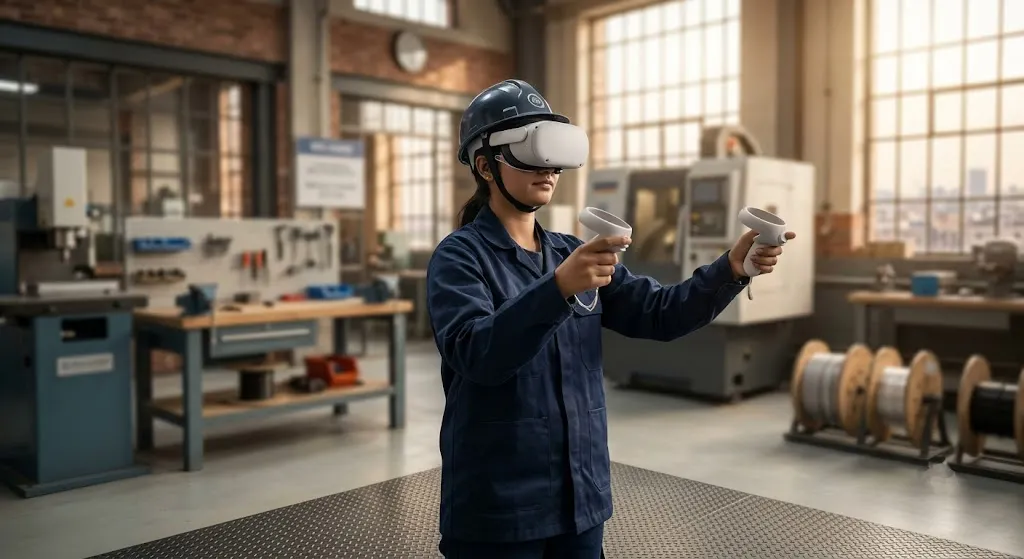
The way organisations train their workforce has reached an inflection point. For decades, standard onboarding and skill-building programs have relied on static manuals, PowerPoint slides, and passive compliance videos. But when employees face high-stakes, hazardous, or complex scenarios in the real world, theoretical classroom knowledge rarely translates into instinctual performance.
Virtual Reality (VR) is breaking this disconnect. By replacing passive observation with immersive, hands-on muscle memory, VR training is setting an entirely new benchmark for retention, workplace safety, and operational excellence.
Below is an in-depth breakdown of why immersive simulations are becoming standard across global industries, along with how choosing the right development partner—such as a dedicated virtual reality company in Lucknow—can transform your enterprise training programs.
The Core Problem with Conventional Training Methods
Every learning and development (L&D) leader contends with the Ebbinghaus Forgetting Curve: within 24 to 48 hours of a lecture or seminar, learners forget roughly 70% to 80% of newly introduced information unless it is reinforced through immediate practice.
Conventional training methods hit three major walls:
- Safety Risks in Real Environments: You cannot easily simulate an industrial chemical spill, an electrical flashover, or a railway coach fire in real life without exposing staff to extreme danger.
- Operational Downtime & Equipment Wear: Taking mission-critical assembly lines, aircraft engines, or heavy mining machinery offline just to train new recruits burns operational hours and cuts revenue.
- Low Engagement & Retention: Watching someone else demonstrate a protocol on video does not build spatial awareness, hand-eye coordination, or sensory reflexes.
VR bypasses these barriers by creating photorealistic, fully interactive digital twins of plant floors, cockpits, hospital wings, and control stations where trainees learn by doing.
5 Practical Reasons VR is Reshaping Modern Workforce Training
1. Zero-Risk Simulation of Dangerous Environments
Certain operational procedures carry zero margin for error. In heavy manufacturing, aviation, construction, and power distribution, one wrong sequence can trigger catastrophic failure.
In a fully interactive VR environment, an engineer or field technician can make a critical mistake—such as opening a pressurized steam valve out of order—and experience the immediate visual and auditory consequences without a single scratch, downtime incident, or financial loss. This "safe failure" environment eliminates hesitation and builds authentic, split-second decision-making.
2. Drastic Acceleration of Muscle Memory & Spatial Retention
Reading a standard operating procedure (SOP) activates limited cognitive pathways. Moving through a 3D space, reaching out with handheld controllers, inspecting mechanical joints, and pulling real-time virtual levers builds procedural muscle memory. Studies consistently demonstrate that VR learners retain information up to 4 times faster than traditional classroom learners, with significantly higher long-term recall rates.
3. Infinite Repeatability at Reduced Long-Term Cost
While the initial setup of an immersive module requires development investment, the cost per trainee plummets over time. Traditional high-end drills demand recurring logistical budgets: booking physical test tracks, flying trainers across sites, burning single-use safety gear, and hauling equipment.
With virtual simulations, 50 or 5,000 employees can run through the exact same scenario from any location with a headset, day or night, with zero material wear.
4. Objective, Telemetry-Based Analytics
Traditional testing depends on multiple-choice quizzes that prove someone can memorize an answer, not that they can perform under pressure.
VR modules capture precise behavioral telemetry:
- Gaze & Attention Tracking: Did the technician look at the pressure gauge before opening the line?
- Reaction Times: How many seconds did it take to identify the hazard and press the emergency shut-off?
- Procedural Accuracy: Were the lockout-tagout (LOTO) steps completed in the legally mandated order?
Trainers receive granular, automated performance dashboards that highlight exact skill gaps across the team.
5. High-Impact Standardisation Across Geographies
When companies operate plants and hubs across multiple cities, ensuring uniform safety standards is notoriously difficult. VR ensures that an operator in Lucknow, a technician in Pune, and a site engineer in Dubai experience the exact same high-fidelity training module, eliminating trainer-to-trainer variability.
Primary Industrial Applications of VR Simulations
| Industry | High-Impact VR Training Use Cases | Core Benefit |
| Manufacturing & Heavy Industry | Machine assembly/disassembly, preventative maintenance, lockout-tagout (LOTO) protocols | Eliminates production downtime while training on expensive machinery |
| Logistics & Transportation | Railway safety drills, emergency evacuation, heavy vehicle maneuvering, crane operation | Safely tests hazard recognition under extreme weather or mechanical failure |
| Energy & Utilities | High-voltage electrical grid maintenance, oil & gas rig drilling safety, chemical leak containment | Removes physical fatality hazards during initial training phases |
| Healthcare & Pharmaceuticals | Cleanroom sterilization procedures, complex surgical walk-throughs, patient emergency response | Replaces textbook learning with exact spatial and tactile practice |
As businesses across Uttar Pradesh and Northern India modernise their operational pipelines, finding a partner capable of bridging high-end 3D graphics with practical business logic is essential. That is why TechQRT is a VR company that forward-thinking organisations rely on to replace clunky legacy training with custom, enterprise-grade virtual simulations.
Positioned as a premier VR company in Lucknow, TechQRT develops tailored virtual environments for complex industrial, technical, and corporate scenarios. Rather than offering rigid off-the-shelf templates, TechQRT works directly alongside plant heads, safety managers, and operations directors to translate intricate SOPs into intuitive, real-time virtual experiences.
Why TechQRT Stands Out as a Transformation Partner
- Custom Digital Twins Built from Real Workflows:
- Whether modeling intricate factory lines, hazardous materials handling, or high-traffic transport hubs, TechQRT engineers detailed 3D models and interactive mechanics directly from engineering diagrams, CAD files, and client safety manuals.
- Full Lifecycle Integration:
- As an established virtual reality company in Lucknow, TechQRT handles the entire development pipeline: from scenario storyboarding and 3D asset creation to physics programming, headset deployment (Meta Quest, HTC Vive, Pico), and backend LMS integration.
- Focus on Measurable ROI:
- TechQRT does not build VR for novelty; every module is built around clear business metrics—lowering compliance errors, slashing onboarding hours, cutting equipment wear-and-tear, and improving audit scores.
- Strategic Regional Advantage:
- For businesses searching for the best virtual reality company in Lucknow, TechQRT offers local collaboration, responsive sprint turnarounds, and direct hands-on support without the high overheads and impersonal communication typical of offshore agencies.
Roadmap: Transitioning from Manuals to Virtual Reality
Adopting immersive learning does not require overhauling your entire training department overnight. A measured, step-by-step rollout yields the highest return:
- Pinpoint the High-Risk, High-Cost Bottleneck:
- Identify the single process in your organisation that causes the most accidents, generates the highest equipment downtime, or takes the longest time for trainees to grasp.
- Draft the Scenario Decision Tree:
- Outline the exact right moves, the common errors trainees make in the field, and what sensory consequences should occur when an error happens.
- Build an Interactive Proof-of-Concept (PoC):
- Work with an experienced VR development team to produce a single, focused 10-to-15 minute simulation module.
- Benchmark Trainee Metrics:
- Run a cohort through the virtual simulation and compare their error rates, confidence levels, and task completion times against peers trained via traditional methods.
- Scale Across the Curriculum:
- Integrate verified modules into your standard learning management system (LMS) and gradually expand to cover ongoing certifications and advanced emergency protocols.
Workforce development is no longer about checking off boxes on a compliance sheet. It is about equipping teams with instinctive, practical competence before they ever step onto a dangerous factory floor or touch sensitive hardware.
By collaborating with a dedicated technology partner like TechQRT, organisations can turn training from a sluggish operational overhead into a lean, data-driven competitive advantage.